|
Star Tradition from a Mysterious Past
m
the stars. Once, a
worldwide astro-mythological teaching seems to have
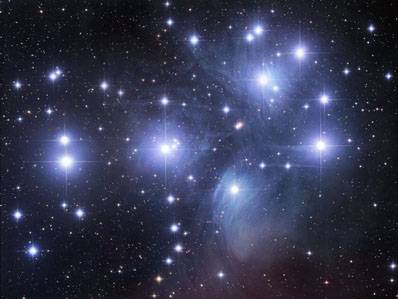
Thus the Pleiades were signaling and initiating “the wet season” and then they became emphasized furthermore by other signals from a next following star group, the Hyades, in Greek ‘to rain’. Later in antiquity,
Greek and Roman authors enjoyed to write about the especial popular
stellar group of the Pleiades, to which there already existed several
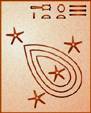
mythological accounts. For instance, the Pleiades group is depicted on the ancient Egyptian vizier Senmut’s 3,500-years old star map - i.e. these stars are placed on the map on the spot where the Pleiades are situated in the sky. More so, on the map the specific picture have been attached some hieroglyphs showing clearly to be read in the direction from the right to the left, displaying the name mw(jt) nwt ht , i.e. ‘the watery bodies’, ‘the humids’, or ‘...of moisture’. The now so famous
Senmut map is adorning the ceiling of his tomb (Thebes Tomb 353, at Deir
el-Bari near Luxor) which like a tunnel is leading beneath Queen
Hatshepsut’s Temple of Hathor, goddess of the sky. However, a certain
analysis of the map reveals such kind of information being of greatest
importance in connection with the history and chronology of antiquity -
the detection was made by Ove von Spaeth. His discovery was first
published in 1984 (in the Magazine ‘Stjernerne’) - and later added
further scientific details, now published as the treatise: “Dating
Egypt’s Oldest Star Map”, in “Centaurus Magazine of the History of
Mathematics, Science, and Technology” (Vol. 42:3, July 2000, pp.
159-179). The ancient knowledge on stars, concerning astronomy, celestial geometry, astrology, and the time keeping, was a particularly important issue in a comprehensive teaching which thus existed in the ancient communities. In Egypt an observatory at the top of the moongod-son Khonsu’s shrine in the temple of Karnak/Thebes is known from very early times. And even from the very earliest times astronomical lines of sight were used as a plan for the main axes in the temple constructions. Also in the
construction of the three great pyramids at Giza, ca 2500 BC, studying
the stars became a very great occupation. For instance, by observing the
pattern of the form of the Orion constellation the ancient astronomers
seem to have identified a pattern relationship by having this star
system as the template used for the geographical _Layout of the three
Great Pyramids and their specific location arrangement on the building
site. Also, ancient temples were considered literally as a holy piece of heaven reflected into the geography on Earth. More examples: the ancient Babylonians/Assyrians directly referred each of their major cities to certain stars - e.g. Nineveh (cf. Moses’ “Book of Genesis” 10:11), the city’s name meaning ‘wild boar’ also being the totem of that city and a name of the constellation “the wild Boar” (: our Great Bear/Charles’ Wain/Big Dipper). With their sky-yardstick the Babylonians measured degrees of arc by use of a certain terrestrial measure, ‘the royal cubit’. Through their many
years of archaeo-astronomical studies, researchers Robert Bauval and
Wayne Herchel independently of one another detected (in 2005-2006) that
the ancient Egyptians used even very accurately the little group of
pyramids in Abusir - which is located exactly on an extension line from
Giza - to represent the Pleiades on this “celestial map on the
ground”.
The temples and the stars Gregory J.
Retallack, professor of geological sciences at the University of Oregon,
carried out a study exploring bedrock geology, topographic setting,
compass orientation, soil profile and plant cover - at 84 temples of
Classical (480-338 BC) mainland Greece, several Aegean islands and
Cyprus (Antiquity, vol. 82, 2008, pp. 640-657). A striking pattern
emerged: the soil appeared to be directly connected to the mythology
surrounding the god or goddess honoured by the particular temples. Some of the Egyptian temples have been constructed in a way connecting to the star of Sirius when - each year in the summer after a period of invisibility of 70 days - it rose (i.e. its Heliacal rising) together with the sun that the light would travel down the temples’ main corridor. In that moment, Sirius would place its shining spot on the altar in the innermost sanctum of the temple. For instance, this is the case with the Egyptian temple of Isis in Denderah, a temple build as a copy of more ancient temples. When the altar was hit by the beam, the Sirius star was thought to be transformed into Sothis, Egyptian Sobdet, i.e. the name for Sirius as a star god. She was special version of Isis, the greatest goddess. On the basis of the same understanding a similar principle was already involved in connection with previously mentioned Hatshepsut’s Temple of Hathor, which, by its axis directed by the line of winter solstice, also could receive the beams of the (in the mythology: seven) stars of the Pleiades. This was interpreted in a way that the beams were being transformed into the Egyptian celestial goddess Hathor’s seven female judges to judge mankind. Similarly, the
Greek temples later - for instance in the very Parthenon - were
constructed with the direction to the beams of the stars of the
Pleiades. Thus, when the temples were oriented geographically to receive
these beams of light into the inner sanctums, the light-rays were
described in a symbolic way as being “transformed into seven women”,
i.e. “the Seven Sisters”, the Pleiades. In Pharaoh Ramses II’s Great Temple from ca. 1240 BC, constructed in massive rock at Abu Simbel in southern Egypt, the axis of the temple was precisely positioned by the ancient Egyptian architects in such a way that twice every year, on October 21 and February 21, the first rays of the morning sun would penetrate the entire length of the temple-cave sanctuary, ca. 61 metres, into the innermost shrine and illuminate the four sacred sculptures, the gods seated there at the back wall. In fact, according
to calculations made on the basis of the heliacal rising of the star
Sirius (Sothis) and inscriptions found by archaeologists, such date of
Ramses II’s jubilee. the celebration of the thirtieth anniversary of his
coronation day (often made to be a pharaoh’s official birthday) must
have been ca. October 22. The image or statue of the king was considered
as enhanced and revitalized by the energy of the solar star.
The mystery of the seventh Pleiades Gajus Julius
Hyginus (64 BC--17 AD), Latin author and the appointed (by Emperor
Augustus) director of the Palatine Library, writes in his work
“Astronomica” (Poeticon Astronomicon, 2:21): At all the places this constellation is, in addition, often called “the young women” or “girls”. I this way the star cluster was seen also by the ancient Hebrews as well as by America’s Coyote Indians in Oregon and the Iroques Indians. Also by e.g. the Dyaks and the Malaysians on Borneo these stars are exactly counted as “seven of which the one is invisible”; and by Australia’s Aboriginals who, too, call them “the young girls”. They are called by this name, likewise, on the Solomon’s Islands in the Pacific. And on the Northern Sumatra this 6-star constellation is called “Bindtang Tudjohc”, i.e. ‘of the 7 stars”. All this could
refer to a much older age of the concept of the star system than most
historians today would like to accept. Ancient, widespread civilizations
of prehistoric times - being traced and discovered more and more by
modern science - could have existed several places on earth. And from
some of these connections the Hebrews, the Greeks, and the Egyptians
seem to have possessed such a heritage - “the 7 young women”, “the
sources of blessing”, “the humids” - and have carried it further on.
Moses ‘took away’ the seventh daughter Jethro’s long-term
historical reputation in the Middle East among Arabs, Jews, Druz, and
other faiths bear witness that he was not any common priest, but a
personality who after 3500 years remains honored as a significant sacred
figure. (Further reference, cf. chap. 15 in Ove von Spaeth’s book: “The
Suppressed Records”, vol. 1 of the series Assassinating Moses; reprinted
2004). Maybe, maybe not,
an extraordinary connection is contained in “the Book of Job” - its
narrative in the Bible is the most presented with archaic Hebrew
and on a 3500-year-old background. The oldest parts were written by
Moses according to all existing ancient traditions of the text’s origin.
A famous quote could possibly be from an in earlier times still kept
impression of a loss of the seventh Pleiade which apparently failed to
remain being fixed on the firmament: “... Canst thou bind together the
brilliant Pleiades? ...” (Book of Job, 38:31).
Transatlantic versions of constellations As with the
prehistoric world’s widespread, common ideas on the Pleiades something
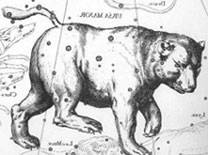
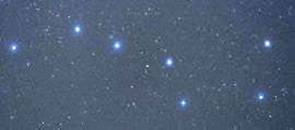
similar is seen regarding the constellation Ursa Major, i.e.
Great Bear - also known as Big Dipper and Charles’s Wain. This
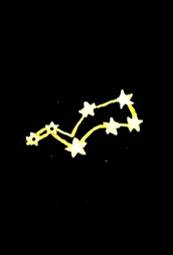
constellation of its own seven-star-group is a non-existing tail-bear -
strangely enough known all over the world. This is except on the Senmut
star map where it is shown in quite another version. Yet it has still
been placed correctly - near the top of the celestial World-axis. And this is even a bear with a long tail - non-existing in any earthly zoological issue or concept - i.e. an identical “fantasy” product re-found across the oceans. The above mentioned idea about a past “intercontinental” range of even several cases of identical names of stars/constellations seems not only based on an apparently wide spread knowledge of a principally uniform astronomical system; especially with matching identical features in the symbols of the 12 sections of the zodiac. Such agreements concern several other identical astronomical names or descriptions.
In the New Empire of Egypt of 18th Dynasty, from ca. 1580 BC, a very tall, new-type obelisk was often favoured in Upper Egyptian capital Thebes. All these cultic stone objects represented the first earthly (‘mountain’) top receiving the first golden beams that lit up the world. These,
consequently, gold covered obelisks (with gold on the small pyramid
shaped top - the capstone or pyramidion; - however, some researchers
suggest the obelisks were covered entirely with gold) were named like
persons and made sacrifices for, and had a sun cultic function.
They expressed ideas of the same kind as the World-axis concerning
relations to the primal light of the world.
centre. Here, shown with a glyph, indicating the pharaoh’s extra name: Son of Ra.
Right:
The ancient Chinese sign Re or Ri, ‘Sun’, became for
technical reasons of
To this it should be added that similarly with this almost identical pronunciation of Ra/Re (Ri) the Chinese still use in their special writing the very same pictographic sign for the sun as the ancient Egyptians. It is the well-known ancient symbol of a circle with a dot in the centre (in later Chinese pictography the circle has been changed to be square-like, for reasons of a calligraphic writing technique). When, for example, children make drawings of a sun it is always just a circle - possibly equipped with rays or a face - but never a circle with a dot in the middle. The very specific sun symbol consisting of a non-empty circle contour and “characteristically made” with its centre-dot as the ‘core’, is therefore no coincidence when it is found in the same special form both with the ancient Egyptians and the Polynesians, and in the Chinese script as well. Similarly, both the Chinese and the ancient Egyptians have a glyph or symbolic sign showing a scorpion. According to the ancient traditions of astrological significances, for instance in use among the Greeks and the Romans, the celestial sign of Scorpio (originally the constellation named Scorpio) may symbolize or refer to “huge quantities or numbers”; and when a picture of a scorpion is used as a hieroglyph in an Egyptian text - or as a writing sign in the Chinese writing still used - this also means the same thing in both of these written languages, i.e. “huge numbers”. In the same symbol concept at all the places the by nature toxic Scorpion signified also something concerning death, and America’s Mayas called this particular constellation also “the sign of the god of death”. Also the stars known by us as the Gemini have the same Greek and Babylonian name or meaning, and the same is the case with the ancient inhabitants of the southern Pacific Ocean. Heritage from
earlier civilizations? Archetypes? For all these examples too it goes
that the concepts and designations they had in common are hardly each
time just a coincidence, but could indicate a form of transport of
traditions. For example, this could have taken place via the ancient
seafarers, who, all over the world at all times navigated by means of
the stars. Thus, the spreading of some of the mutual ideas could also
have been done in this way; although it was not necessarily the only
way.
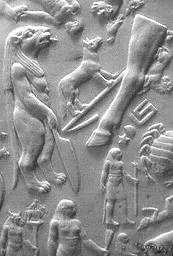
Older symbolism on Senmut’s star map Regarding the former, often a worldwide common star symbolism, it is interesting that the Egyptians did not let the constellation Great Bear/Big Dipper called by such name, but either Kepesh (hpsh) or especially Meshkitu, i.e. ‘ox shank’. In ancient myths, and also in the Bible, the hip, loin, thigh, or lower back can refer metaphorically to the birth process or rebirth and was also known as a euphemism for the reproductive organs. The New Testament’s text, “The Revelation of St. John the Divine”, is mentioning the “whore of Babylon”; - this was a symbol of Charles’ Wain (Great Bear) - according to Dante’s “Divina Commedia” from ca. 1300 AD, when the cultic initiated in their knowledge still had kept a part of ancient cosmology tradition. There is a difference between the constellation’s internal unity and movement speed. For example, the Pleiades star group is considered fairly stable - especially the seven or six key stars out of its entire group of more than 40 stars - as precise measurements show that the Pleiades are moving in exactly the same direction and with quite the same slow pace, i.e. they stick together in relatively close group over many millennia which is quite unique in the universe. The Aztecs in Central America based their calendar on the Pleiades stable group. It is a different
story when it concerns the Great Bear constellation who changed
dramatically through the millennia. On Senmut’s star maps from around
3,500 BC and in numerous other ancient Egyptian images the constellation
Meshkitu can be seen - the Great Bear/Big Dipper - with its shape
in a version being is unusually flat. In addition, in this version on
the Senmut star map it is even given head with horns to underline the ox
symbolism.
Ove von Spaeth
- - - -
-
Allen,
Richard Hinckley: Star Names, Their Lore and Meaning, (1899)
rev. ed. (Dover), New York, 1963. Mallwitz, Alfred, & Wolfgang Schiering: Die Werkstatt des Pheidias in Olympia, I, Olympische Forschungen, V, (Walter de Gruyter), Berlin (1964), 1991.
Retallack , Gregory J.: Rocks, views, soils and plants at the
temples of ancient Greece, Antiquity, Vol. 82, No. 317, 2008, pp.
640–657.
Spaeth,
Ove von:
Dating Egypt’s Oldest Star Map,
Centaurus Magazine of The History of Mathematics, Science, and
Technology, vol. 42:3, July 2000, pp. 159-179.
|