|
Knights Templar searching
Middle East for secret knowledge
By
OVE
VON SPAETH
.
Copyright © 2013 -
www.moses-egypt.net
Throughout several hundred years, evidently the Knights Templar
sought
open-mindedly for extraordinary parts of ancient knowledge
in the
Orient. In many very important ways this knowledge
contributed to a new
development of Europe.

Searching for too kinds of treasures
When the Knights Templar order was established in Jerusalem in 1118, and got
fully Papal acknowlege in 1129, they seem already in the first decades to
have been searching for ancient objects of a special kind. Judging from
their later results in Europe it is not unrealistic to assume that the
knights had some success by having managed to find something of great value.
The popular belief is that the Knights Templar were “hunting” not least such
impressive objects as the Ark of Covenant and the Holy Grail. But in reality
it seems that it should not be understood literally. But it becomes clear
that, certainly, this did not prevented them from excavating and explore the
underground tunnels - possibly finding something of value there.
The Rabbinical Writings mention that the biblical figure, Korah,
participated in the Israelite exodus from Egypt and was originally was one
of Pharaoh’s fiscal managers, - and that later a famous branch of his
descendants, the Kohatit clan, were supervisors and gatekeepers of the
Jerusalem Temple treasures and equipment. Korah - who also assisted with the
practical part in the casting of the Golden Calf - knew much about handling
gold and gold mining.
All this is in full agreement with the conditions during in particular
Egypt’s 18th and 19th dynasty (ca. 1560-1200 BC), where the pharaohs’ fiscal
managers also carried out gold coating and gold casting.
The Bible recounts later in detail about how many values and precious goods
the Babylonians took from Jerusalem’s temple already 500 years prior to the
Romans’ similar actions. And even before all that, the Egyptian Pharaoh
Sheshonq (Shishaq), 925 BC, stole all the precious values from Jerusalem’s
first temple, the very temple of King Solomon.
After the Romans in 70 AD ransacked Jerusalem and its great temple, the
market suddenly became so overloaded that the gold prices dropped to about
50 percent of the previous value among the Romans and in the Mediterranean
countries in general.
It gives some idea about the wealth and riches of Jerusalem and its
religious centre, the famous temple. So, how much more has been stored and
hidden already during the anticipation of the Roman attack?

Relief of the Titus Arch in Rome, showing the spoils from the Temple of
Jerusalem just before
it was destructedt at September 1st, 70 AD, which
became a Jewish traditional Memorial Day.
The reason for the military action was that a Jewish rebellion was stopped
by the Roman general Titus. The situation was exploited by his father,
Emperor Vespasian - who needed huge sums to his costly construction of the
Colosseum – now to proceed the fight with extra effort and then absolutely
outrageous, also looting the temple.
The Bible carefully describes also the original Solomon temple, but many
historians of modern times call this description a myth and claim that “no
temple like that have existed”.
However, many of them changed their views because in 1980 there was a major
archaeological discovery in Ain Dara in south of Syria - a temple not only
from the same time and of the same size but also with at least 33 exactly
the same details as in Solomon’s temple - almost as its mirror image. The
biblical description was no illusion.
Moreover, there was even found very ancient reliefs, depicting camels
(dromedaries), a fact incompatible with many academic allegations that
camels - which, for example, are early mentioned in the Bible - only had
existed as domesticated animals much later in history.
Much later, in the year 1118, the first group of the Knights Templar settled
in Jerusalem at a certain place beneath the temple square, in the remnants
of the so-called Solomon’s stables.
These ancient constructions seem to have had no connection with King
Solomon’s temple, because just to reach the archaeological layers of the 975
years younger Herodian temple of the time of Jesus, the Knights Templar
would have to dig down, at least 46 metres.
Supposed traces of the original Solomon construction will then exist further
deep down. But as it becomes clear certainly these facts did not
prevented the Knights Templar to excavate and explore the underground
tunnels.
The big mystery of the Knights Templar’s hidden treasures
The Knights Templar got several of their first major value-acquisitions from
the Middle East, often probably from some ancient well-hidden treasures in
the Jerusalem aerea. On this new basis the Knights Templar were with their
network in a situation that nicely contributed to that they were able to
invent and create something so fantastic as the first international banking
system, which increased their treasures immensely.
It was the first time an international organization made it possible that a
person who on his journey would carry with him a fortune from, for example,
England to “the holy land” (Israel/Palestine) - now, instead of hiring
guards for its protection during the journey - he could pay the amount in a
templar office in England. Then by showing a receipt which was codified (an
early forerunner of the modern credit card system) he could receive an equal
sum at his arrival in the Holy Land.
It was the Knights Templar who invented the checks and credit systems, and
the Church gave them permission to receive interest payments (although it
may be interpreted as being against Moses’ rules in the Bible) - they could
receive up to 10 percent as interest. And they were allowed be free of
paying tax - neither to the kings nor the Church.
Moreover, since the Knights Templar individually were not allowed to own
anything, their fortunes and estates increased so drastically that they
could lend large sums to kings and emperors, who always had confidence in
the Knights Templar. It was much based on the independence of the Knights
Templar and their great ability to protect entrusted property. For example,
the Knights Templar in France had from 1261-1264 stored and protected the
crown jewels of the English king Henry III.
The loans were often more in the form of credit or guarantees and security
deposits rather than cash. This seems to be one of the main reasons that
when the French king Philip IV (Philip le Belle, 1285-1314) - supported by
the Pope - wanted to dissolve his enormous debts and by a coup destructed
the Order of Knights Templar to seize their values, it was a great
disappointment to him that the legendary treasures had totally disappeared.
Their big land estates existed - but the values as concrete money and gold
could hardly be found at all.
The Knights Templar had beforehand succeeded in hiding another part of their
treasures very well, and in some cases secretly sent them away onboard
ships, for instance, to Scotland where the king was quarreling the Pope and
kept the country out of the Pope’s ban of the Knights Templar. In Scotland,
the wealthy family St. Clair of Roslin suddenly became super wealthy.
The historian Marilyn Hopkins points to that from a location like the
habourcity La Rochelle 18 ships of the Templar fleet left France close to
the time of the destruction of the Knights Templar Order, (Hopkins: “The
Knights Templar. Their History and Mystical Connections”, 2006).
Also from Mallorca, the big island in the Mediterranean so strategically
well-located island of which the Templars owned the majority, the Knights
Templar rescued their treasures and brought them, via Spain, to Portugal.
But ca. 200 years earlier, on the basis of the Knights Templar’s huge
property managements these knights already were very active behind
establishing of the, in fact, astounding amount of cathedrals all over
western Europe.
By the support the knights could provide with money, technical consult, and
solid inspiration; sometimes not of the offers were preferred, for instance
in the case of the construction of the Chartre Cathedral which was paid for
by the citizens and the local nobility.
In addition, these huge activities included an entirely new kind of building
construction, and a large amount of advanced knowledge had been necessary to
provide for this purpose. Again, the Knights Templar could have come upon
the trail of ancient valuable knowledge through the intensive searching
operations which they were carrying out in the Near East and especially
Jerusalem?
 
Left:
Latest discoveries of tunnels, after Colonel Warren expedition in the
1860's, occurred by the
International Parker Expedition 1909-1911. The later included Dominican
priest and archaeologist H. Vincent reported the expedition results in text
and photographs in his book: "Jerusalem sous terre" (London, 1911).
Right: In August, 1909, Captain Parker arrived in Jerusalem, and
Turkish Governor Azme Bey would collaborate.
The Cobber Scroll - a treasure map?
Even in the Shara Mountains in what is today’s Kingdom of Jordan, the
Knights Templar also arrived and settled in Petra, the hidden, mysterious
rock city. Also, at another place, more northern in these mountains the
local Bedouins are still talking about a “biblical treasure” which has
exited in these regions.
In addition, their information is based on the Bedouins’ handed down
traditions concerning an English Knight Templar who, ca. 1120 according to
western European calendar, was searching for the Ark of Covenant or its
remnants. However, near Mount Nebo, where the Ark of Covenant might have
been hidden in the area of
Moses'
tomb with its otherwise unknown exact location, he found instead, what was
not so bad, - a golden coffin. Later, he and his group brought it to
England. The following will establish that some treasures of this kind
actually existed here.
Most of the temples of antiquity, especially in Egypt and Israel, were of
many functions in one: a most sacred place for worship and place for animal
sacrifices, a high court, an university, an office for calendar and
astronomy, a central library, a tax- and financial centre (cf. Jesus driving
out the changers of money), and treasure keeping.
In the greatest manuscript discovery of modern times, many ancient Hebrew
texts with biblical and sectarian contents were found in eleven caves, in
1947 and onwards. The location is within a few kilometres of ancient ruins
on a plateau overlooking the mouth of Wadi Qumran near the Dead Sea.
One of the texts is written in a curious scroll, the Copper Scroll (now
designated “3Q15”), found in 1952 in Cave 3 at Khirbet Qumran. The Copper
Scroll lists many of the hiding places of many real treasures presumably
from the Jerusalem temple.
Regarding the scroll’s mentioned hiding places of the temple objects, one of
the places is described as existing in the Judean desert, namely a cave or
tunnel. In modern times it was found by philologist John M. Allegro, one of
the great Qumran text experts.
The site was re-examined more than 40 years later by archaeologist, dr. Oren
Gutfeld, of the Hebrew University in Jerusalem. (O. Gutfeld: “Hyrcania’s
Mysterious Tunnels: Searching for the Treasures of the Copper Scroll”,
Biblical Archeology Review, 2006, Vol, 32:5, p. 46).
Although the mentioned site had been found, it also appears here - as at the
other sites also based on the Copper Scroll’s mentioning of about 60
locations in today’s Israel, out of 64 mentioned sites - namely, that some
treasures hunters, very likely with a copy of the text, had made a prior
visit. Perhaps early, each of these places has been emptied, either by
stealing the objects or by a strategic removal.
The text is a listing of sixty-four locations in all, also stating city and
street names. Sixty-three of the locations described in the Copper Scroll
holding treasures of vast quantities of gold and silver, as well as many
coins and vessels.
Assessing the value of the described objects would not be precise, since not
we are being sure what the weights given in the scroll are actually
equivalent to. However, it would have to be estimated in the tons. The total
value of this would comprise more than one million US dollars in accordance
with the high dollar value in 1960. So the weight designation should
possibly be changed in the translation.
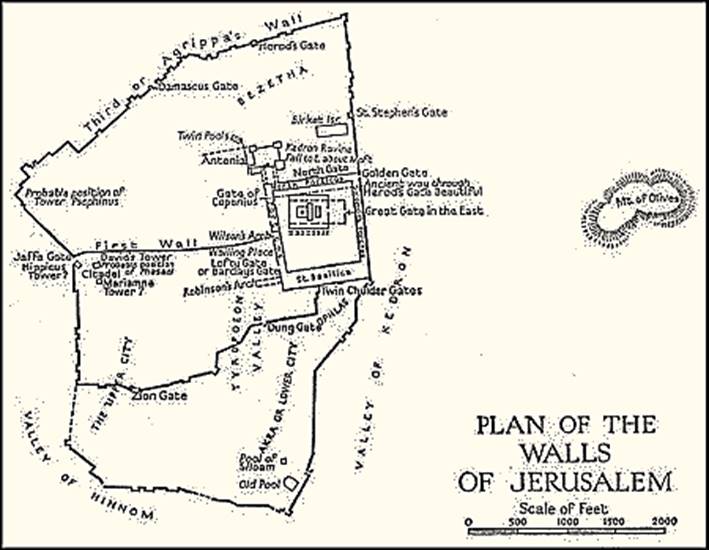
Map of Jerusalem's walls and the location of the temple.
Also a treasure of cultic information?
The Cobber Scroll was made of alloyed copper, obviously for better
preservation. The entire text has been reversed like a mirror image.
Also, it is engraved like “writing” on copper with a stylus and here
making it as an elevated writing. Both results appear as if the text on the
scroll was used for copying by a kind of printing process (as by block
printing, reversed image, at that time certainly known from Asia).
The final listing are pointing to a duplicate document with additional
details. Some scholars believe that this document could be the so-called
Silver Scroll - a scroll which archaeologists are still searching for in the
Israeli desert.

The Copper Scroll from the caves of Qumran contains a codified list of
precious
objects from the Temple of Jerusalem - regarding where they
were stored in safety.

Reading the Cobber Scroll offers a true challenge. Deciphering the unusual
orthography reveals that the Hebrew text is mixed with ca. 30 strange
(deliberate?) errors or mistakes which are of a kind normally not to be
made, but they could have been created by purpose like a code.
This is also including the anomaly that seven of the names of locations are
followed by a group of often two or three Greek letters. In all, there are
14 Greek letters - scattered, but from if they from the start follow one
after another the first group spells the name, Akhenaten.
The scribes belonging to the sect, which seem to have contributed to the
existence of the Qumran texts, have thus included an Egyptian name. This was
the name of the Pharaoh Akhen-aten (Tuthmosis IV) whom in thoses days is
assumed to have been forgotten for more than 1000 years after he had
prioritized a sectarian-philosophical version of the Egyptian religion in
the connection with a special the sun god, Aten. The præsentation of
Akhenaten’s name is not written according to Egyptian pronunciation but is
tinted by Greek and Aramaic.
Using terms from special steps of the older Egyptian religious teaching was
not unusual during the Gnostic influenced era.
By here, we must pay attention to the almost unknown fact behind the
narrative in the Greek-language New Testament mentioning that Jesus rode
into Jerusalem through its eastern gate, the Ram gate (the sun’s site of
raising) sitting on the back of the “female donkey’s colt”: in Hebrew this
special term is: aten - a version of the Egyptian god of the sun!
Also, the New Testament describes a 3-day episode of a clearly cultic
inaugural ritual with a death-like sleep and reviving, where the candidate’s
name is Lazarus. This is a Greek-Semitic version, el Asar-os,
of the Egyptian god of resurrection, As (later, better known in Greek
as Osiris).
On the lists, many precious objects for the temple
service are mentioned with specified information, and even this could be a
codification by a today also rather unknown code method used in the Bible.
For example, in the Hebrew Bible certain words are repeated a certain number
of times: the “Book of Exodus” in chapters 7 and 11 on Egypt’s ten plagues,
the term “Egypt(‘s country)” is mentioned 24 times, (Pharaoh’s) “magicians”
and “servants” also 24 times, and “Pharaoh’s people” 12 times, “the houses”
12 times, etc. Similar rhythms of numbers are seen in the instructions for
the interior of the temple (tent) and in other the Bible texts on festivals,
law, and genealogy records.
It was not a procedure out of normal in Antiquity. Later, also the texts
which are traditionally ascribed to Homer turn out to accommodate this magic
extra dimension by such kind of method. It may provide the solution of the
alleged change of style in the Iliad’s long and somewhat tedious listing of
ships and their crews, especially in Book 2. (cf. Florence & Kenneth Woods:
“Homer’s Secret Iliad, the Epic of the Night Skies decoded”, 1999).
Regarding the Dead Sea scrolls, several did not came from the Temple library
in Jerusalem originally. The Israeli general, Yigael Yadin, was also the
legendary archeologist who in 1963 - in Massada’s synagogue (ruin) built by
the Zealots - excavated copies of certain Hebrew texts which, similary, were
found in Cave 4 (“Cave of Letters”) of Qumran.
The aforementioned English semitolog, John M. Allegro, reproduces in his
book, “The Dead Sea Scrolls” (rev.ed., Hamondsworth 1958) - and further
detailed in one of his scientific papers, “Qumran Cave 4 (Oxford 1968) -
information on the biggest discovery, namely, the 550 texts in Qumran Cave 4
- including texts on the sect practicing astronomy and using astrology. -
Some of this information has been reproduced with special code characters.
Still, the content was not much different than what one could expect to find
also in documents from the Jerusalem temple.
It is documented in general and concretely that such texts really existed
and, likewise, it is a solid fact that the Knights Templar were also
searching for exactly such writings.
Therefore, all the above realities presented will dismantle any allegation
of that it is just romanticized ideas that the Knights Templar could find
cultic, spiritual, and advanced technical knowledge.
The ‘Gold’ of the ancient Temple libraries
In Antiquity, collections of scrolls (documents, acts, books) were precious
treasures - a library containing considerable knowledge was worth a fortune.
From the ancient Egyptian temples and their ruins we know that such
treasures of documents of often invaluable knowledge were kept in safety in
the temples’ most protected part - in stone walled library rooms side by
side with the inner sanctum.
Jewish-Roman historian Josephus, 2,000 years ago, had invaluable sources
about the history of the Jews, - also because of Titus Caesar (Vespasian),
the conqueror of Jerusalem, gave Josephus scrolls confiscated from the
Jerusalem Temple on its destruction in 70 AD.
King Ptolemy II - about 2,300 years ago - had ordered all ancient books and
documents from the libraries of the temples all over Egypt to be collected
in his new great library of Alexandria. No wonder, when this metropole
became antiquity’s main center of learning, through more than 800 years. The
texts from the gathering, at approx. 300 BC, were of the Egyptian knowledge
traditions being far more ancient than any early Greek influence.
Besides their many holy scriptures the ancient temple libraries contained
texts of all kind, from history to account keeping but especially also
astronomical texts for time keeping and information on cyclic phenomena. In
addition there were cultic texts with secret rituals but also with advanced
scientific as well as spiritual learning.
Egyptian-Jewish historian Artapanos, around 100 BC, and other ancient
writers - including Egyptian historian Apion, about 50 AD - and several
Church fathers, including Eusebius (9:27) - all are stating about Moses at
Pharaoh’s court in Egypt such information: he was with his special talents
the inventor of several machines and equipment such as crane machinery to
move large rocks, water lifting devices for irrigation, and different
equipment for arms production and shipbuilding. Because of his high position
at court Moses was able to get such ideas introduced. - Irrespective of
Moses’ possible role here, at any rate it shows that in Antiquity people had
concrete ideas of such machines.
With such information, which also was to be found in Egypt’s ancient temple
archives, which material was collected in Alexandria, Artapanos also
mentions Moses’ Egyptian secretary from Memphis, Nacheres (Egyptian name
Na-ka-re). Nacheres took notes and handed over Moses’ ideas regarding
better use of livestock, including extension of drawing power from two oxen
coupled with a yoke - at that time new in Egypt.
Such sparse information may today be added to what archeology in the Middle
East has been able to detect from the discoveries of Antiquiy’s different
kinds of devices. But even in the Bible (Exodus 35:30 ff) the name is
mentioned of Moses’ head craftsman, Bazal(el), who also has been linked with
the construction of the Tabernacle.. It can resemble King Solomon's temple
builder architect, Hiram Abiff, who with his knowledge of sacred geometry
later got great symbolic importance for the Masons.
Many inventions in connection with Moses disappeared again. Similar
circumstances were seen later when many of the wealthiest Romans on their
huge estates in the south of France acquired a kind of harvesting machinery,
which eventually was forgotten in one and a half millennium - and was then
in principle re-invented shortly before 1900 in Europe and USA.
Moses’ construction of the Israelites’ new calendar, known from the ancient
Rabbinical Writings and the Bible, also demonstrates a fine knowledge of
astronomy. The Rabbinical Writings state that Moses led major works in Lower
Egypt, and Apion reports that Moses let develop some of his specially
constructed “obelisk pillars” simultaneously designed to be used as huge
sundials. Such an idea was after 1,500 years seen again in Rome where the
Romans used one of the Egyptian obelisks which they had seized.
Moses’ insight and practice of alchemy and medicine is stated in the
Rabbinical Writings and for example in connection with the biblical episode
of his transforming of the Golden Calf into gold dust to put in water to
drink.
.
This kind of knowledge and those documents which Moses was interested
in and also seized in the ancient temple libraries, when the Israelite
exodus from Egypt started, have also included mystery cultic “magic”
knowledge, in which many people later on in history would have wanted
extremely to gain insight.

Bernard of Clairvaux had the central post behind the Knights Templars
organisatio.
The painting showing him receiving envoys.
Special knowledge behind constructing the new cathedrals?
About 1000 years ago much advanced and secret knowledge from Antiquity had
been eradicated by the Church, although not all of it. Notably, Roman
architect Vitruvius’ work on the ‘sacred’ geometry of ancient architecture
was re-published several times through history. Even among Church leaders
advanced knowledge from the past was highly valued.
At the time when the Order of the Knights Templar was founded their chief
ideologist and protector, the French abbot Bernard of Clairvaux, clearly was
very well-informed on the special teachings from the ancient initiation
cults. For example, he “defined God as: height, length and depth” - and the
handed down knowledge obviously inspired his visions of the new cathedrals’
construction style and the design’s expression of spiritual, “celestial
aspirations”. Bernard of Clairvaux certainly was well aware of what he could
commission the Knights Templar to trace.
But Bernard of Clairvaux, could he also have obtained special knowledge from
Jewish sources, for example about what might be hidden inside and outside
Jerusalem regarding treasures and important information?
In Roman times, in most of the first centuries AD it is well-known from
history that many Jewish emigrants arrived from the Near East to southern
France. It is from that time we hear about the legend of Mary Magdalene's
arrival on the Mediterranean coast of France.
Charlemagne, 742-814, who had France as the basis for his re-established
West Roman empire, claimed that he was in his line back in time connecting
to Jewish kings in Israel, back to David. It may sound somewhat extreme, but
not necessarily totally wrong in case he pointed to ancestors.
It was common, even necessary that distinguished families knew in detail the
family tree far back in time. Also, it was known that the Romans had sent a
Jewish king, Herod Antipas, in exile in southern France where he received a
big estate and spent the rest of his life.
It has meant something special that a great Christian monarch and also the
Pope's equal, on Christmas day 800 when he was crowned emperor, claimed such
connection - also if the succession from the biblical kings was more in a
symbolic sense.
The Frankish Emperor Charlemagne and the nobility encouraged Jewish
emigration into the empire as a state policy, as a key to international
trade. Could the strong Jewish reputable features in the less homogeneous
French society at that time also have contained certain traditions of a
continuously and protected maintaining of ancient knowledge?
Also, it was under the reign of Charlemagne that the knighthood arose to its
more mature form. This at that time relatively new concept, with rules for
some special combatants serving a Christian leader, also made it possible to
establish the Order of the Knights Templar in a later century.
For about 200 years later, in the years 1100-1300, in fact hundreds of
Gothic cathedrals were constructed across Europe, inspired from the East by
certain parts of Hermetic knowledge now reintroduced by this mystical order
of monk-knights, the Knights Templar.
During the Knights Templar settlement and carrying out excavations at the
temple ruins in Jerusalem dating back to King Solomon in the 900’s BC, the
knights discovered the earlier mentioned vaults, some of which possibly
contained hidden knowledge and certain artifacts.
Among other things there seems to have been scrolls concerning the
alchemical knowledge and sacred geometry and architecture, science of sound,
and astronomy. Ancient sacred relics are also said to have been in the
Knights Templar’s cache of discoveries there.

Bernard de Clairvaux, by Alonzon Cano (1601-1667).
The construction of the huge number of the great Gothic cathedrals, some of
the most famous at Chartres, Paris (the Notre Dame), St. Denis, Cluny, and
Salisbury, were inspired by these transforming discoveries. The sublime
edifices protrude as monuments to the rediscovery of ancient mysteries, a
new elevated awareness, and were constructed using the principles of what
was often designated as sacred geometry, harmonic acoustics for their
transforming potential.
Religious architecture ‘embedded’ in these towering structures reflected a
new alchemical-knowledge inspired way of establishing the light. The
manufacturing method of stained glass in the church windows was not fully
revealed and later often forgotten, but modern research shows that it
contains an addition of certain metal oxides. An incredibly beautiful blue
colour in the glass was a well kept secret, today we know that it is due to
cobalt oxide and/or cobber dioxide.
Other of the old sources inspired to the building construction’s specific
acoustical properties for the sacred music and chanting, thus contributing
to the new custom of constant rounds of choirs performed by the monks.
In Cologne the world's second tallest Gothic cathedral and with the largest
facade area (7,500 m²) was founded in 1248. The cellars enormously thick
walls are built according to the secret old rule of having entirely the same
weight as all the giant cathedral which they carry.
Therefore, if the Knights Templar in their search even found anything at all
- today very few facts of relevance seems known - most possible they have
been able to find documents of certain importance (often stored for that
very reason). Also, in such cases they would discover valuable knowledge and
exclusive information, not only from the ancient cults’ psycho-spiritual
experience systems but also of a technical nature from the past.

Jerusalem surrounded with thick walls - which the city was provided with
already far back in ancient times.
Some Knights Templar guidelines and certain cultic rules are known, and were
given by Bernard, who was deeply religious. Usually, Knights Templar had to
pray seven times a day. Some prayers would be in connection with meditation,
which he was strongly in favor of. During battles these warrior monks
achieved an inner strength that made them almost invincible. And never
afraid to die. They were respected and feared - a rule was that they were
not to escape except when the enemies were six times as many.
For each Templar elite warrior there have been post asigned up to ten other
men: squires, builders, blacksmiths, clarks, cooks, bankers, etc. The
Knights Templar also had a scientific elite group and its often advanced
discoveries and results seem to have been in conflict with the church's
official policy and dogma, therefore, these people had to work less
conspicuous.
The Order’s political enemies in Europe claimed that the Templars
“worshipped” Baphomet, the significance of which is debated in research. But
the name does not exist in any Templar document. It is a code even known
from the Dead Sea texts. According to this Jewish abash code - a
method at least from ca. 500 BC and much used for the Bible - the mysterious
name Baphomet = Sophia (Greek: ‘wisdom’), a deity principle
even much cultivated by the Gnostics.
The last to be heard about the Baphomet name was when the French King Philip
IV included it in his accusations in 1307 against the Templars to be
arrested for heresy.
However, later Church policy changed eventually. Danish writer and
researcher Erling Haagensen demonstrates in his book, “Accused for Silence“
(Copenhagen 2007), that the Church has also destroyed medieval archives
containing scientific information of the greatest importance for humanity,
and thus delayed with at least 400 years a development of humanity.
The fact that the Knights Templar in their religious, cult practice had
certain secrets - which could help to strengthen their unique invincible
courage, discipline and dedication - is today full of mystery with many
features which in several cases obviously have been included also from
initiation in the Middle East’s very ancient cultic and spiritual knowledge
tradition.
The real leader of the Knights Templar, Bernard of Clairvaux, quoted genuine
ancient knowledge, and mentioned God directly in connection with mystery
doctrine of “holy” ratios, etc. The fact that he possessed such knowledge
reflects a former tradition of many among Church scholars. Even the ancient
Church’s most esteemed philosopher, St. Augustine, was well-versed in this,
and among other things he expressed that
“... Mathematics and figures were provided to us by God so that we could
verify the existence of truth ...”
Ove von Spaeth Copyright
© 2013 -
www.moses-egypt.net
Read the entire book
- to be downloaded from here: http://www.moses-egypt.net/zenith-files_en/e-books_group1_en.asp
#####################################################################
|
